History of the forest
How the forest survived a thousand years: barrows of ancient tribes, hunts of dukes and kings, an imperial palace, the fellings of two wars, a reserve and a national park.
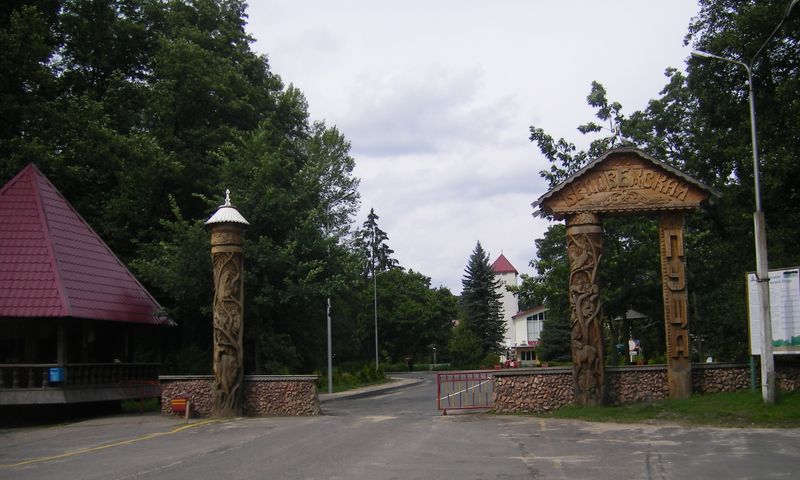
Forests once covered almost the whole Brest region. The Pushcha survived for a reason: its land is strewn with boulders and was poor for ploughing, and there were no rivers to float timber down. The tribes who lived in the forest lived off the woods rather than farming. They are remembered by barrows strung out along the Narewka, the Narew and the Lesnaya: a few date from the Milograd culture (7th-3rd centuries BC), most from the 11th-13th centuries.
The royal forest
Its wealth of game made the forest a hunting ground for rulers. Vladimir Monomakh, Traidenis, Gediminas and Jogaila hunted here; in 1409, after the congress in Brest, Jogaila held a great hunt in the forest to lay in provisions for his army. From the 15th century the forest belonged to the grand dukes of Lithuania and the kings of Poland. Its riches were put to use: under Sigismund Augustus potash and iron were produced, tar was distilled, and at the end of the 16th century logging began. But protection went hand in hand with exploitation: in 1558 a law protecting the royal hunting grounds was issued, in 1577 the bison came under protection, and families of forest guards were settled to look after the forest and the hunts. In 1639 a survey of the forests was carried out; its results were published as the Ordinance of the Royal Forests.
The tsars' forest
In 1795 the forest became part of the Russian Empire. Hunting became almost unrestricted, bears and beavers were wiped out completely, and parcels of forest were handed out to favourites. The fire of 1811 and the invasion of 1812 caused further damage. Change began under Alexander II: bison hunting was banned, and from 1864 red deer were brought in from Germany. In 1888 the forest became the property of the imperial family, and a hunting palace was built in Białowieża, where Alexander III and Nicholas II hunted. This period is described in the essays Russian emperors in the forest and The tsar's hunting palace.
Wars and the reserve
During the First World War the forest was under German occupation. Sawmills were built and about 300 kilometres of narrow-gauge railway laid to haul timber; traces of one line can still be seen on the tourist trails. The forest's last wild bison was killed by poachers in 1919. Between the wars the forest belonged to Poland: a reserve was created in the centre, but elsewhere an English concession carried on logging.
In December 1939 the forest, now part of the Byelorussian SSR, was declared a state nature reserve. After the war, in 1944, the border divided it into a Belarusian and a Polish part. In 1957 the reserve became a reserve and hunting estate, and in September 1991 the Belovezhskaya Pushcha National Park. In 1992 the Belarusian part was inscribed on the UNESCO World Heritage List together with the Polish part, and in 1993 it became a biosphere reserve.
Essays
- Timeline - key dates in the history of the forest
- Prehistoric people in the forest, the Yotvingians
- Royal hunts in the chronicles
- Russian emperors in the forest, the hunting palace in Białowieża
- 600 years of protection