Bus tour of the forest
A guided bus tour of about 50 km: the giant oak, the Empress Pine, the Tsar's Road, the Lyadskoye Reservoir, Father Frost's Estate and the enclosures.
- Type
- Guided tours
- Length
- 50 km
- Time
- 2 h
- Stops
- 27
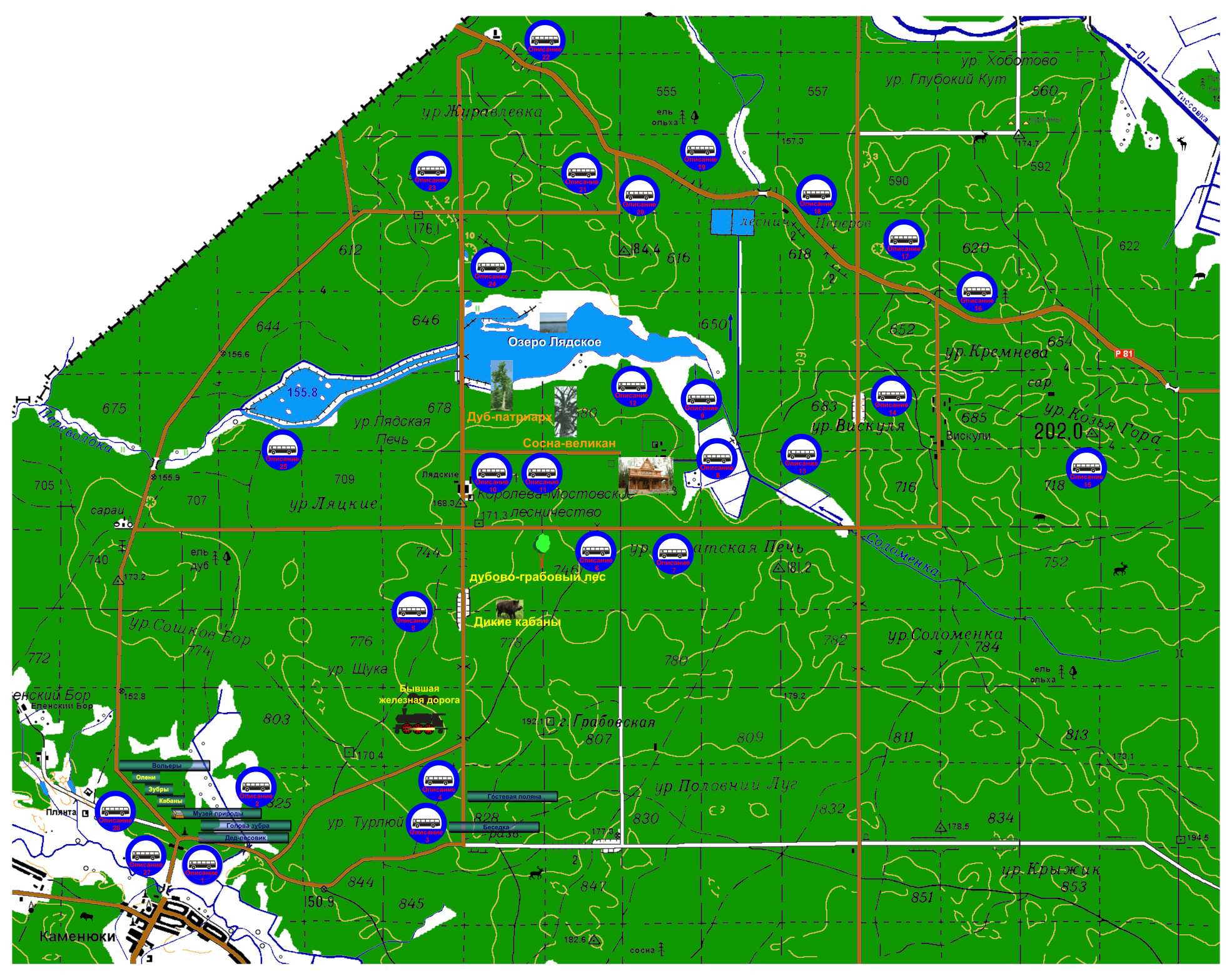
The bus tour is the easiest way to see the highlights of the forest in a couple of hours. The route, about 50 kilometres long, starts and ends at the main entrance to the national park in Kamenyuki; a guide accompanies the group, and the bus stops at the most interesting places.
Along the way you see many types of forest, from pine woods to ancient oak and spruce stands, beaver dams and the forest's reservoirs, a birch with a burl shaped like a bison's head, an oak and a birch grown together, ivy on a birch trunk - Europe's only evergreen climber, the 600-year-old giant oak and the 350-year-old Empress Pine, the Tsar's Road of 1903 with its little bridges, whose double-headed eagles were restored in 2005, the Falling Crosses memorial, the Lyadskoye Reservoir, Father Frost's Estate and finally the enclosures with bison, deer, wild boar and other forest animals.
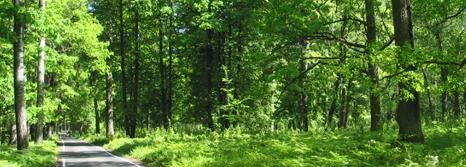
Below is a short version of the guide's commentary that accompanied the tour on the old website, section by section; the full commentary is on the Russian page. Some figures in it date from the 2000s: the current area and zones of the park are on the Zoning page. Timetable and prices are on the national park's website.
Stops
- 1
At the main entrance: remembering 1941
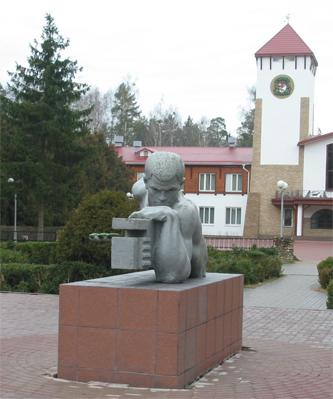
At the main entrance stands a sculpture of a machine gunner. It commemorates a battle of 27 June 1941 in compartment 612 on the Kamenyuki - Białowieża road, where a Red Army unit cut off behind German lines held up enemy convoys for a whole day. Two young machine gunners were killed; their names - Zhaken Baisambekov and Aktyubakbar Makhmudov - were established only forty years after the war, while the third soldier, Ilya Goncharov, was badly wounded and hidden by local farmers. The guide then explains why the forest matters: it is one of the last surviving fragments of Europe's mixed lowland forest, protected for centuries by the surrounding bogs and by rulers who kept it for their hunts.
- 2
The bison-head birch and the forest spirit
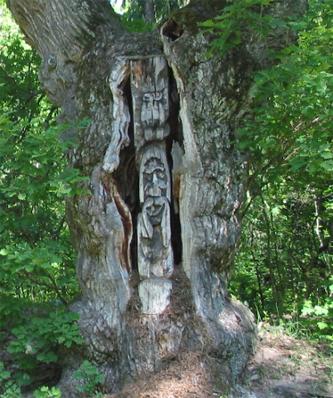
The road passes mostly coniferous woods to the first stop - a birch with a burl shaped like a bison's head, a tribute to the animal saved from extinction in zoos and brought back to the forest. Nearby, in the hollow of an old oak, sits a wooden sculpture of a forest spirit. The road to compartment 828 is nicknamed the "mother-in-law's tongue": it has some thirty bends in four kilometres, because in the 1960s the old dirt track was simply surfaced rather than straightened. Pines grow on the higher ground, spruces in the hollows and black alder along a stream; woodcock, kingfishers and wild ducks live here, and hoofed animals graze on the Dokudovo meadow - the guide tells stories of wolves, lynx and a hare that outwitted a fox.
- 3
The national park and its forests
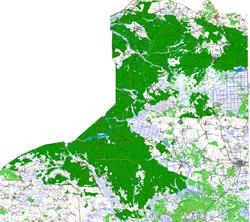
The Belarusian part of the forest is a national park of about 150,000 hectares stretching along the border in a strip 68 kilometres long; about 58,300 hectares - more than a third - is the strictly protected zone. The forest stands on a gently rolling plain on the watershed of three river basins and has a mild, almost maritime climate. The guide describes its rich mixed woods with centuries-old trees, the role of forests in cleaning the air and stabilising the climate, and why seeds from old trees are especially valuable. By an arbour whose roof rests on an upturned tree stood a forest guard's lodge; such lodges have gone, but many forest tracts still bear the names of the guards who lived there.
- 4
The glade of tar burners and charcoal pits
At the second stop, a broad glade, there were once a tar works and charcoal pits: in the mid-18th century the last king of Poland, Stanisław August Poniatowski, tried to set up profitable industries in the forest. A grassy mound by the entrance hides leftover charcoal and wood. After inspecting his works the king held feasts here, and the feasting place has been recreated - a big fire pit, oak stump tables and seats, woodpiles and arbours where the king and his retinue sat.
- 5
Compartment posts and forest rides
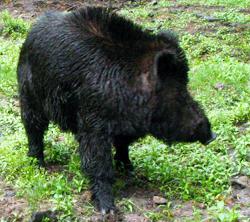
Beyond the glade stand white posts with numbers on all four sides - compartment markers. From them, rides run strictly west-east and north-south every kilometre, so it is almost impossible to get lost. The numbering is shared by the Polish and Belarusian parts, since the grid was laid out when the whole forest belonged to the tsars. In the early morning and evening wild boar cross this stretch of road on their way to the nearby oak wood. The straight road itself follows a former narrow-gauge railway, and further on lies a large boulder that may once have been a ritual stone.
- 6
Protecting the sessile oak
Four compartments of the forest are set aside to protect the sessile oak, which in Belarus grows only in the west. The guide explains how an acorn sprouts, why a young oak grows slowly for its first years while it builds its roots, how it can put out a second flush of shoots in summer and why foresters say it likes "a fur coat but no hat" - shade from the sides but not from above. Oaks have early and late forms that drop their leaves at different times, and the sessile oak, listed in the Red Book, is a separate species with stalkless acorns.
- 7
Red wood ants and tits
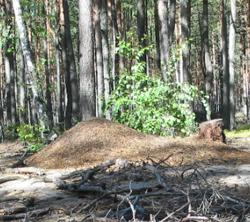
Old pine and spruce stands line the road - the favourite habitat of red wood ants, the forest's sanitary squad. There were once eleven large anthills here; only six remain, because wild boar and woodpeckers damage them in winter. A tit eats 50-60 grams of insects a day, a large anthill ten to fifteen times more. Woodpeckers, in turn, feed on bark beetles and clean themselves in anthills - which matters, since the forest's spruces have been attacked by the bark beetle four times in half a century.
- 8
The upper depot and the forest railway
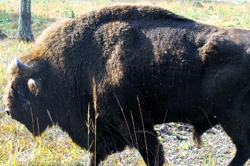
The asphalt road here was once a narrow-gauge railway used to haul timber, and the regular rectangular glade beside it was an "upper" depot where logs were stacked before being loaded onto trains pulled by small wood-fired engines. The bark that fell from the stacks suppresses seedlings, so even after more than seventy years no trees have grown here. The guide also tells the story of the bison breeding centre: the first pens covered 24 hectares and were later enlarged to 170; in 1953 half of the bison were released into the wild, and in 1968 all of them.
- 9
The bison glade and rare plants
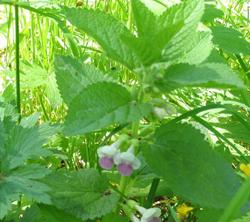
On the right is a glade created by thinning the dense woods to improve conditions for the bison. Mowing and browsing keep shrubs down, so grasses and flowers thrive: this sparse oak wood shelters 14 of the 47 vascular plants in the Red Book of Belarus, among them ladybells at the northern edge of their range, several kinds of bellflower and the lady's slipper orchid, which flowers only in its 17th or 18th year.
- 10
The 600-year-old giant oak
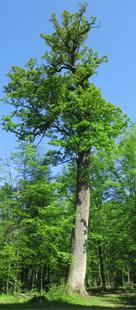
The fourth stop is one of the oldest oaks in the forest: about 600 years old, over 30 metres tall and some two metres across, with about 60 cubic metres of wood. Low on its trunk is a saw cut left by a timber company in the 1920s, which apparently gave up when it saw the tree was hollow. Locals believe that an acorn from this oak, planted elsewhere, makes a wish come true. The guide tells of the oak as the sacred tree of the thunder god Perun - oaks really are struck by lightning more often than other trees, and this one bears the scars - and points out a giant elm and moss-covered maples nearby.
- 11
The Empress Pine
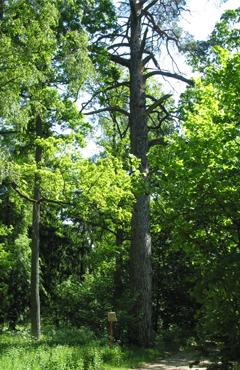
At the fifth stop stands the Empress Pine, almost three and a half centuries old. Old pines like this were once used for keeping bees: the heartwood was hollowed out and a swarm settled inside, each beekeeper cut his mark into the bark, and robbing a hive was punishable by death. The guide also talks about amber - fossilised pine resin - and the legends about its origin.
- 12
The feeding site and the bison centre
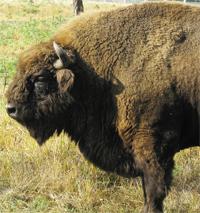
On the left is a winter feeding site. Even after their release, bison return here in winter and depend almost entirely on people: each gets about 10 kilograms of hay and 8 kilograms of beet and potatoes a day. The animals know the gamekeepers' voices, and at feeding time a herd of up to a hundred follows the cart. In hard winters red deer gather by the bison feeders too. Nearby are a trap used to catch bison for resettlement in other Belarusian forests, an observation tower and a small house built soon after the first bison arrived - the sixth stop.
- 13
From the bison centre to the Pererov crossroads
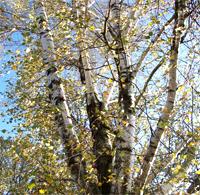
From the bison centre the tour continues either past the road to the government residence at Viskuli or through the Teplukhi tract to an old mixed forest in compartment 683. Fodder stores for the bison stand by the road, which then runs for about a kilometre between drainage canals across hay meadows - a bog turned into a polder in 1964, where the ground still trembles when a tractor passes. The guide describes the birch and its uses, from baskets and boxes to the birch-bark letters that are among the oldest Slavic writing.
- 14
The giant ash
On the right grows a giant ash, more than 200 years old, over a metre thick and more than 40 metres tall. Ash does not live as long as oak, but it withstands browsing by deer: a tree a metre and a half high may be thirty years old. Beyond it lies a permanent research plot of old maple and ash forest - maple woods have all but disappeared in Belarus - and a stand that grew back naturally from seed on an old felling. The road climbs onto the spurs of Kozya Hill.
- 15
Kozya Hill - 202 metres
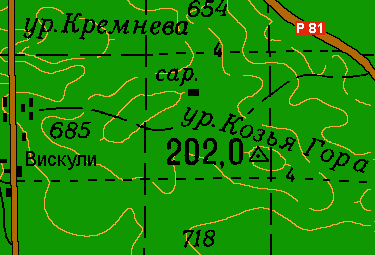
Kozya Hill, 202 metres, is the highest point of the forest. The watershed between the Black Sea and the Baltic runs here: streams such as the Perevoloka and Solomenka flow into the Lesnaya, then the Bug and the Vistula, while rivers on the other side of the ridge head for the Pripyat and the Dnieper. Watersheds deserve special protection, as they mark the boundaries of animal and plant regions. The logging road to the Pererov crossroads was built in the 1970s to keep traffic away from Viskuli; the guide quotes an old description of the impenetrable windfalls of the forest.
- 16
Black alder woods
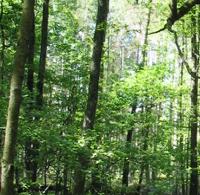
In a damp hollow the road passes thickets of black alder. Alder logs were once supplied to heat the tsars' palaces - they give little soot or fumes - and were called "royal firewood". Freshly cut alder wood turns from white to red and then soft pink as it dries; its leaves fall green after the frosts, and nodules on its roots fix nitrogen and enrich the soil. Its floating seeds are spread by floods, and the cones are a traditional folk remedy.
- 17
The forest's spruce woods
Next come dense spruces. Spruce woods are a small share of the forest, but spruce grows as an admixture almost everywhere. The forest lies at the south-western edge of the spruce's continuous range, and its shallow roots make it suffer in dry years; weakened trees are attacked by bark beetles, and affected trees are removed to stop the spread. In autumn the remaining stumps are covered with honey fungi.
- 18
A mixed forest and the pine sawfly
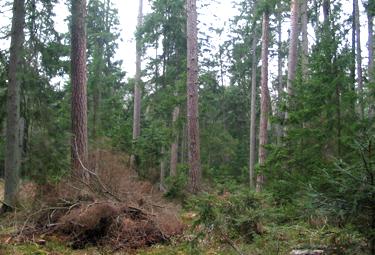
The forest is a mosaic of tree species, and this diversity protects it. When the pine sawfly ravaged pine forests in Belarus and Poland some years ago, Poland spent millions on aerial spraying to no avail, while in Białowieża not a single tree died: mixed stands and the pest's natural enemies held it back. Almost every type of pine forest is represented here on a small area, and even in winter conifers keep producing oxygen. The road reaches the Pererov crossroads.
- 19
The Tsar's Road
The route continues along the Tsar's Road, built so that the Russian tsars could travel to the hunting palace in Białowieża, destroyed in the Second World War. Small bridges along it once carried large double-headed eagles. When the imperial train passed, villagers lined the road, garlands hung over it and barrels of burning tar lit the way; Nicholas II last visited the forest in 1912. The road passes the old Pererov forestry estate, whose house now receives guests.
- 20
The lake by the estate and the forest's birds
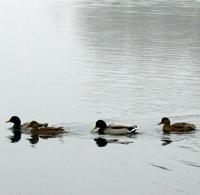
Near the estate is a lake loved by swimmers and anglers. The forest's lakes are a paradise for birds: the mute swan, absent from 1920 to 1963, was reintroduced with four birds brought to the Pererov lake and now nests on all the reservoirs. Goldeneye, bittern and greylag geese breed here, and great egrets are seen ever more often. The guide lists the forest's wildlife - wolf, lynx, marten, otter, mink, beaver, white-tailed and golden eagles - and a white stork colony at the forest edge with eight pairs nesting in one tree.
- 21
Pine forests
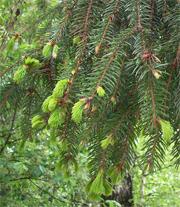
Past an overgrowing sphagnum bog the road enters conifer forest where spruces and pines reach almost 40 metres. Pine is the main tree of the forest and has always been prized: it yields resin for turpentine and rosin, used in dozens of industries. The painter Ivan Shishkin worked in the forest in 1892, making studies from nature that were exhibited in St Petersburg the following year.
- 22
Jean-Jacques Rousseau and the border
The philosopher Jean-Jacques Rousseau once planned to settle in the forest, but a swindler put him off Poland and he chose the outskirts of Paris instead. Thanks to its preserved ecosystems the forest became one of the most studied areas in Europe - "the main forest of Europe", as the journalist Vasily Peskov called it. The road reaches the second border post, named after Kofanov; in the 2000s a simplified crossing between the two countries operated here (check whether it works now before travelling). The guide recounts how the border was drawn through the forest after 1944.
- 23
Spruce and bark beetle outbreaks
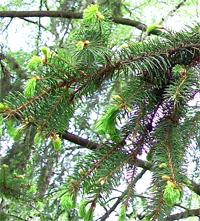
Beyond the border post are felled patches - former bark beetle outbreaks. Spruce is the least stable tree in the forest: it grows at the southern edge of its range and has shallow roots, so after the droughts of 1992 and 1994 many stands weakened and were attacked by beetles. Dead trees are removed in sanitary fellings, but hollow trees are left for birds and mammals such as squirrels, martens and dormice, and the old forest is full of woodpeckers.
- 24
The Lyadskoye Reservoir
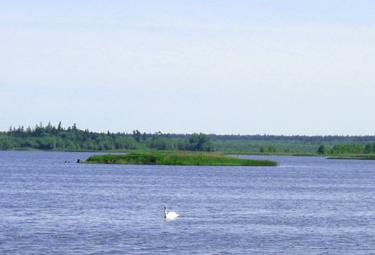
The road leads onto the dam of the largest body of water in the forest, a reservoir of more than two square kilometres with wooded hills rising in tiers behind it. A slide of this view, the cosmonaut Klimuk once said, was used to help cosmonauts relax after training. In the days of the Soviet leaders' hunts, duck eggs were hatched in a white house on the shore so that no important hunter left empty-handed. Great crested grebes, pike, tench and perch live here, and several pairs of swans nest on the reed islands every year.
- 25
Pine stands and overgrown clearings
The road crosses pine woods again - pine dominates the forest - including a bilberry pine wood with a second layer of spruce. On a clearing to the left, wood small-reed has taken over and holds back the regrowth of the forest, and deer, roe deer and bison eat the young trees. The route passes through the small village of Lyadskiye, centre of a forestry district, and the guide notes that the forest's oak woods include the sessile oak, here at its only site in Belarus.
- 26
The wildlife enclosures
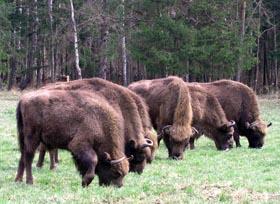
The tour ends at the wildlife enclosures, which are especially exciting for children. Do not climb the fences or enter the enclosures: the animals may come close, but they are wild and get stressed, so be quiet and do not frighten them - or the birds nesting in the boxes around. The enclosures are large and cover a sizeable area of forest. The guide explains why captive animals cannot simply be released and how introducing new species can harm local wildlife, as the raccoon dog has harmed ground-nesting birds.
- 27
Back to the main entrance
After the enclosures the bus returns to the car park at the main entrance, where the tour began. The commentary is based on a guide text written in 1985 by A. V. Dengubenko, L. E. Dvorak, N. G. Dyachenko and A. Z. Strelkov.